
A visual comparison of the mainstream chips
Comparing mainstream UHF Gen2 (RAIN) RFID chips, the visual guide below breaks down core chip anatomy like EPC and User Memory. It contrasts industry leaders Impinj (M800 and M700 series) and NXP (UCODE UX, 9, and 8 series), highlighting their flagship models, specific memory capacities, and shared features. It outlines alternative options from Alien Technology and EM for a simplistic mainstream market overview.
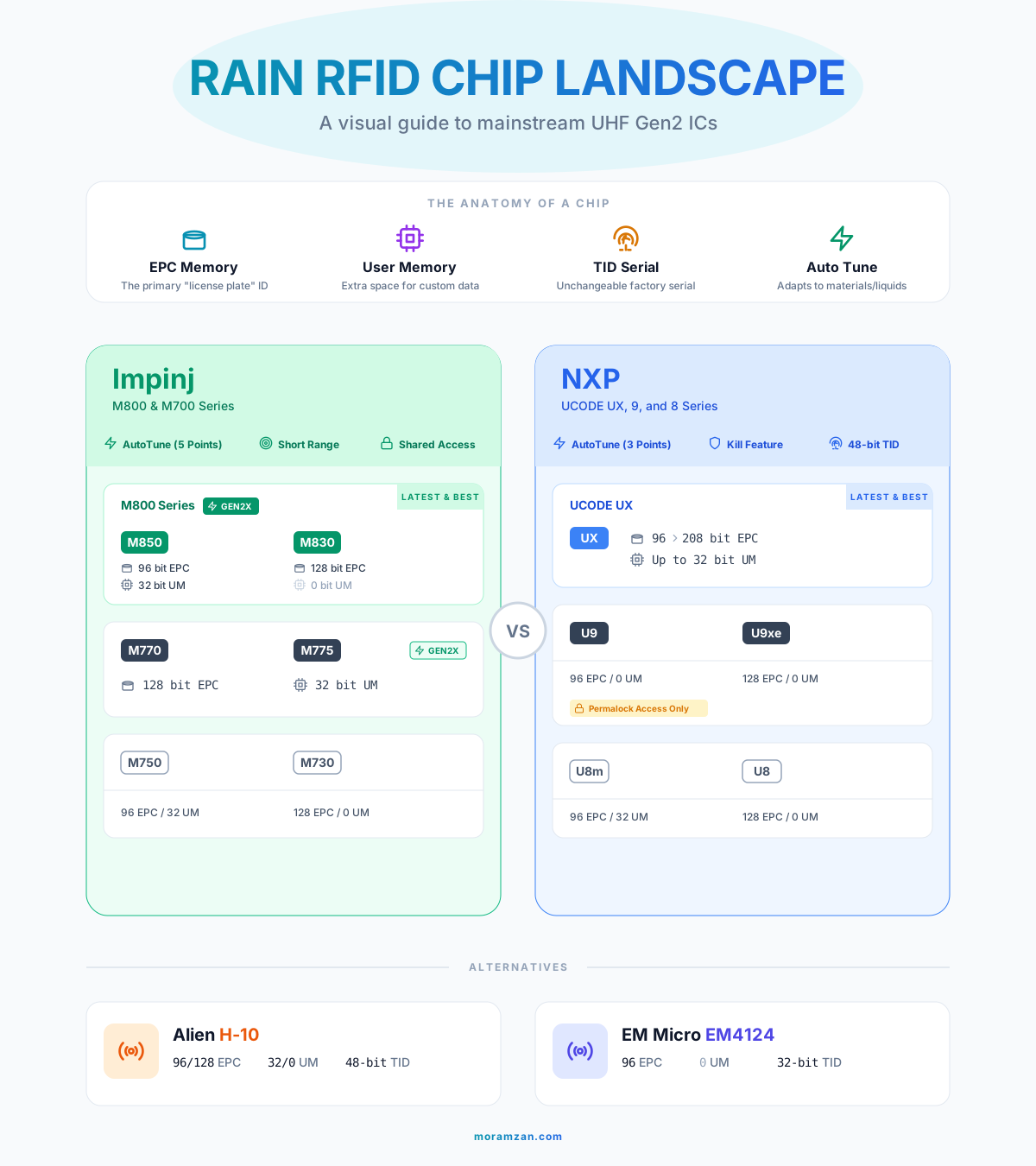
Mainstream RAIN RFID Chip Comparison
The RAIN RFID chip market is dominated by a relatively small group of semiconductor manufacturers, with Impinj, NXP, Alien Technology and EM Microelectronic providing most of the widely available UHF EPC Gen2 tag IC options. Although all four suppliers support standards-based RAIN RFID operation, their portfolios differ considerably in RF performance, memory capacity, privacy features, security and support for specialised applications. Selecting the right chip therefore involves more than comparing headline read sensitivity: antenna design, encoding performance, available inlays, reader compatibility and the intended operating environment are equally important.
Impinj
Impinj’s current mainstream offering is the M800 series, led by the M830 and M850 endpoint ICs. These chips are designed for high-volume retail, apparel, logistics and general merchandise applications where long read range, rapid inventory counting and consistent operation across different materials are priorities. Compared with the previous M700 generation, the M800 series offers improved read sensitivity, lower power requirements and enhanced backscatter efficiency. AutoTune V3 helps tags adapt to changes in antenna impedance, while Enduro V2 improves the physical chip-to-antenna connection. M800 chips also support Impinj’s new Gen2X extensions, which can improve inventory speed, filtering, privacy and tag-data protection when used with compatible Impinj readers.
Impinj continues to offer several more specialised devices alongside the M800 family. The M780 and M781 combine M700-series performance with extended memory for applications such as pharmaceuticals, food, automotive components and manufacturing records. Monza 4QT remains available for applications requiring additional memory and configurable privacy, while the Monza X-8K provides a much larger memory capacity, battery-assisted operation and interfaces intended for embedding RFID functionality inside electronic devices. These products are less likely to appear in low-cost retail labels, but they remain useful where information must travel with the asset rather than existing only in a cloud database.
NXP
NXP’s newest mainstream RAIN RFID platform is UCODE X, introduced in January 2026. It provides a specified read sensitivity of –26.2 dBm, write sensitivity of –23 dBm and fast 32-bit encoding, positioning it for high-throughput retail, logistics, healthcare and food-tagging applications. Flexible memory configurations allow manufacturers to adapt one platform to different EPC and product-data requirements, while full GS1 EPC Gen2v2 support, including the standard Untraceable privacy command avoids dependence on proprietary reader features. UCODE 9 and the 128-bit EPC UCODE 9xe remain important established options, particularly where existing UCODE 8 or UCODE 9 antenna designs and qualification work need to be retained.
NXP also has one of the broadest portfolios for extended-memory and secure RAIN RFID applications. UCODE 9xm provides configurable EPC and user memory, with configurations offering up to 496 bits of EPC memory or 752 bits of user memory. The newer UCODE Nxm, currently described by NXP as a preproduction device, expands this approach with up to 880 bits of shared configurable memory for industrial IoT and Digital Product Passport applications. UCODE Guard adds AES-128 authentication for brand protection, automotive, pharmaceutical and other applications where proving that a tagged item is genuine is as important as identifying it.
Alien Technology
Alien Technology’s current flagship is the Higgs-10, a GS1 Class 1 Gen2 chip designed around improved read sensitivity, write sensitivity and backscatter performance. It is available in several familiar Alien inlay formats, including Squiggle, Short, Squiglette etc. Alien also continues to support earlier Higgs devices: Higgs-9 provides a large-memory option, while Higgs-EC uses the company’s Sentinel self-correcting memory architecture to improve stored-data reliability and write endurance. Alien’s portfolio is therefore particularly relevant where proven inlay designs, robust memory and application-specific tag formats matter more than adopting the newest silicon platform.
EM Microelectronic
EM Microelectronic offers conventional passive Gen2 products such as the EM4124 and EM4126, but its strongest differentiation is found in more specialised devices. The EM4325 can operate as either a passive or battery-assisted passive chip and includes 4 Kbits of memory, making it suitable for sensors, reusable assets and applications requiring greater range or reliability. The em|aura-C adds Gen2v2 security with AES-128 and Grain-128A cryptography, while the em|echo family combines long-range RAIN RFID with smartphone-readable NFC and shared memory on a single chip. The latest em|echo-i supports Gen2v3 and higher-memory industrial applications, while em|echo-lock adds cryptographic protection across both its UHF and NFC interfaces for high-value goods, aviation components and secure traceability.
Summary
For mainstream, high-volume labels, Impinj M830/M850 and NXP UCODE X currently represent the leading new-generation choices, with the final decision likely to depend on inlay availability, encoding infrastructure, reader estate and required privacy features. Alien Higgs-10 remains a credible alternative, particularly for users who value Alien’s established tag designs or require application-specific inlays. EM Microelectronic is the more specialised proposition, standing out where battery assistance, cryptographic authentication, high memory, sensing or combined RAIN + NFC functionality is required. No chip is universally “best”. The most effective solution is the IC and antenna combination that delivers reliable read and write performance on the actual product; is the most cost-effective; and is the right fit for that particular business integration.