
RAIN RFID looks identical on both sides of the Atlantic - same Gen2 protocol, same EPC numbers, same vendors - yet a US-tuned reader pushed into 4 W EIRP across 50 channels behaves nothing like a European reader squeezed into four 200 kHz channels at half the power. The gap shapes read range, dense-reader performance, tag selection, and inventory strategy for any operator running RFID in more than one region. Two regulatory regimes - FCC 47 CFR §15.247 in the US and ETSI EN 302 208 in Europe - set those rules, and a recent ETSI extension into 915–921 MHz is finally narrowing the divide. Engineers feel it as channel-plan logic and link budgets; finance feels it as separate reader SKUs and regional tag inventories. Here is what changes, why it changes, and what to specify.
Two spectrum philosophies, one protocol
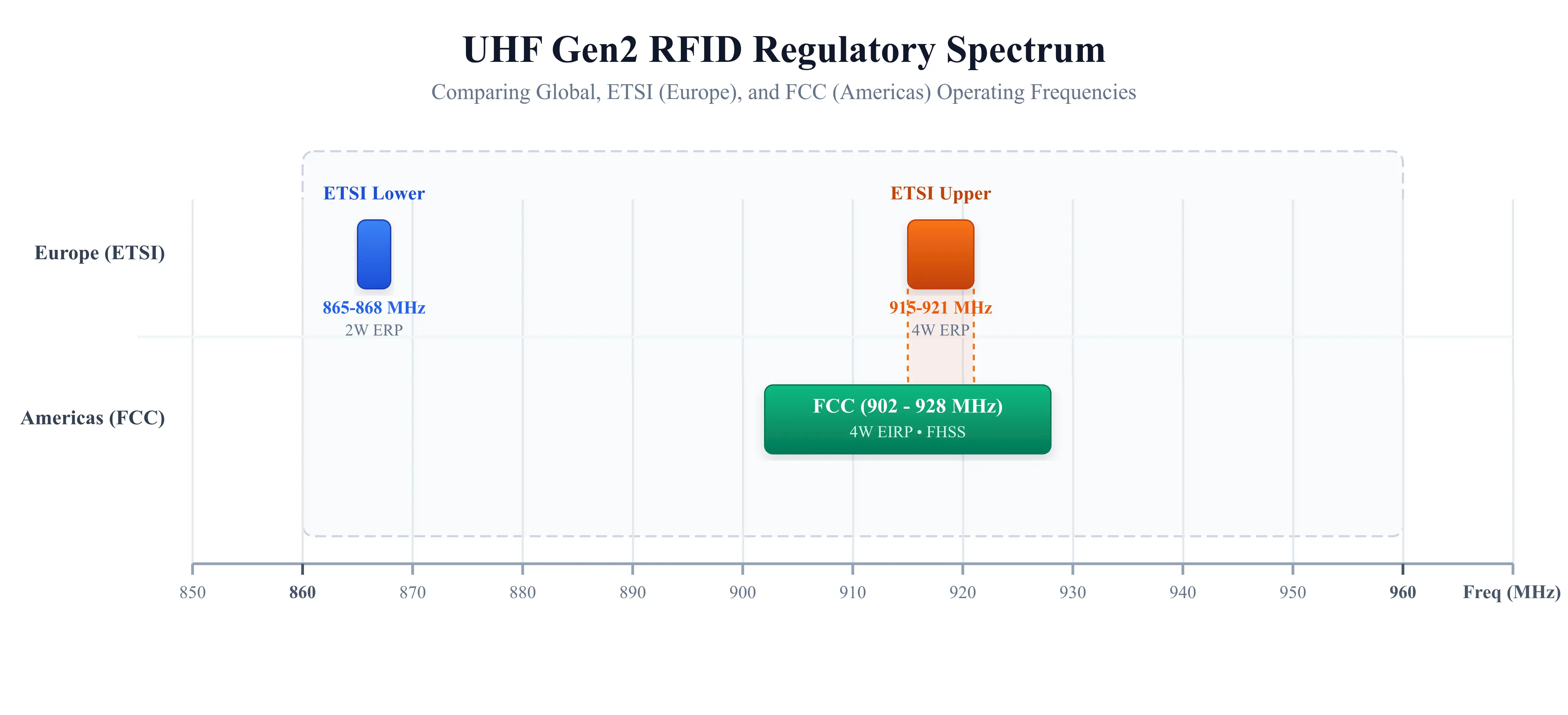
The headline numbers tell the story: FCC gives readers 26 MHz of bandwidth, 4 W EIRP, and 50 hopping channels; ETSI's lower band gives 3 MHz, 2 W ERP, and four channels. Both regions run the same GS1 EPC Gen2 v2 / ISO/IEC 18000-63 air interface - the divergence is purely how the radio gets to use the spectrum.
| Parameter | FCC Part 15.247 | ETSI (Lower) | ETSI (Upper) |
|---|---|---|---|
| Frequency band | 902–928 MHz | 865.6–867.6 MHz | 915–921 MHz |
| Total bandwidth | 26 MHz | ~2 MHz usable | 6 MHz |
| Max reader power | 4 W EIRP | 2 W ERP ≈ 3.28 W EIRP | 4 W ERP ≈ 6.55 W EIRP |
| Conducted limit | 1 W (30 dBm) into 6 dBi antenna | - | - |
| Channels | 50 × 500 kHz | 4 × 200 kHz, 600 kHz spacing | 3 × 400 kHz (EU mandate), 1.2 MHz spacing |
| Spectrum access | Mandatory FHSS, ≤400 ms dwell / 20 s | Polite spectrum access: 4 s on / 100 ms off | "No longer than necessary" - no hard timer |
| Tag emission cap | None | –20 dBm ERP | –10 dBm ERP |
| Certification | FCC ID + TCB testing (readers only) | CE under RED 2014/53/EU |
The current standard is EN 302 208 V3.4.1 (December 2023), which combines both ETSI bands in a single document.
From listen-before-talk to polite spectrum access
Europe's first RAIN regulation in 2004 mandated Listen Before Talk (LBT): a reader sensed the channel at –96 dBm before transmitting. In dense deployments LBT failed badly - at that threshold a 2 W reader is theoretically detectable up to ~80 km in free space, so any nearby reader blocked all others. ETSI dropped LBT in EN 302 208 v1.4.1 (November 2011) and replaced it with the current "polite spectrum access" approach: pick one of four channels, transmit up to 4 seconds while reading tags (1 second if none are detected), pause 100 ms, then resume or hop. There is no carrier sensing.
The FCC took a different path in the 1980s, choosing Frequency Hopping Spread Spectrum (FHSS) because the 902–928 MHz band is shared with federal radiolocation. A compliant reader must hop pseudo-randomly across at least 50 channels, dwelling no more than 400 ms in any 20-second window, with each channel used equally on average (§15.247(a)(1)(i)). Explicit coordination between readers is prohibited (§15.247(h)); collisions are managed statistically across the wide channel pool.
Power, channels, and read range
The widely-cited rule of thumb - FCC readers achieving 8–12 m, ETSI readers 5–7 m on passive tags - is roughly accurate for vendor-published figures, with real-world deployments delivering 50–70% of that. The gap has three causes. First, FCC's 4 W EIRP gives ~0.85 dB more forward-link power than ETSI's 2 W ERP. Second, FCC's 500 kHz channels permit faster reader-to-tag data rates (lower Tari), while ETSI's 200 kHz channels constrain throughput. Third - and most subtly - only Europe limits tag backscatter (–20 dBm ERP in the lower band), which weakens the return link the reader must demodulate.
The new ETSI upper band closes nearly all of this. With 4 W ERP, 400 kHz channels, 1.2 MHz spacing, and a tag emission ceiling 10× higher (–10 dBm), RAIN Alliance reports up to 40% longer reader-to-tag range and 2× faster forward-link data rates. Crucially, 915–921 MHz sits inside the FCC band, so a global-tuned tag reaches near-FCC performance in adopting countries.
Dense reader environments expose the difference
Dense Reader Mode (DRM) is a Gen2 protocol feature, not a regulatory one. Readers use PR-ASK modulation and Miller-encoded subcarriers (M=4 or M=8) so tag backscatter lands in narrow sidebands offset from reader carriers, allowing adjacent-channel readers to coexist without desensitizing each other. DRM works under both regimes, but the available spectrum determines how far it scales.
In a US warehouse with 50+ dock-door readers, FHSS plus DRM provides natural temporal and spectral separation across 50 channels. In an ETSI lower-band facility, only four channels exist - Impinj documents that beyond two active readers in close proximity, careful channel assignment (e.g., Reader A on channels 4 and 7, Reader B on 10 and 13), antenna isolation, and reader synchronization are required. Many European retailers respond by deploying fewer high-gain phased-array overhead readers (Impinj xArray-class) instead of dense portal arrays. The ETSI upper band's three independent channels meaningfully improve density but still trail the FCC pool.
What this means for tags, readers, and inventory
A passive tag's antenna is conjugately matched to the chip - narrowband (Q ≈ 10–25), so a 915 MHz FCC inlay used at 866 MHz typically loses 3–6 dB and 30–50% of its range. Two engineering responses dominate today's market:
- Broadband matching networks plus adaptive-tuning ICs - Impinj M730/M750 (–22 to –24 dBm read sensitivity), the new Impinj M830/M850 with AutoTune V3 (–25.5 dBm), NXP UCODE 9 (–24 dBm), and NXP UCODE X (–26.2 dBm) all advertise global 860–960 MHz operation.
- Region-specific inlays for small inlays, on-metal and high-Q applications; where global broadbanding sacrifices too much sensitivity.
Readers are typically firmware region-locked on a single hardware platform. Impinj's R700 ships as four SKUs (FCC, ETSI, FGX, Japan); Zebra's FX9600 has Global and US variants. The professional installer carries legal liability for region settings - operating an FCC-only reader in Europe risks fines and customs seizure, and voids manufacturer warranties.
For business decision-makers the practical guidance is direct: specify global-tuned tags wherever cross-region logistics matter, budget for separate reader SKUs and country-by-country certifications, and check ETSI upper-band availability for European sites - 34 CEPT countries had adopted it as of mid-2025, including the UK, France, Italy, Spain, and the Nordics, with Germany and the Netherlands still pending because of military and railway band conflicts.
The wider regulatory picture
A global window around 916–920 MHz is emerging. Japan operates at 916.7–920.9 MHz (4 W EIRP, licensed) under ARIB STD-T106; China consolidated into 920–925 MHz under MIIT Announcement 76 (effective 1 November 2024); South Korea uses 917–920.8 MHz; Brazil and Australia operate inside the FCC range. This convergence is why every major IC vendor now advertises broadband 860–960 MHz tuning - even though readers must still be certified region by region.
One US risk worth tracking: NextNav's pending FCC petition (WT Docket 24-240) would compress Part 15 use into roughly 11 MHz and reallocate the rest to terrestrial PNT/5G. The petition has drawn opposition from the RAIN Alliance, AIM Global, and most unlicensed industry bodies, and as of April 2026 no NPRM has issued.
Bottom line
The two regimes embody different bets: FCC trusted statistical spreading across abundant spectrum; ETSI trusted polite cooperation in scarce spectrum. For most of RAIN's history that meant materially different deployments - longer range and denser reader counts in the US, careful channel engineering in Europe. With the ETSI upper band now live across most of CEPT, and global ICs broadbanded across 860–960 MHz, the engineering gap is shrinking even as the regulatory and certification overhead remains. Specify global tags, plan reader SKUs by region, watch the German and Dutch upper-band decisions, and keep one eye on the NextNav docket.